2026 Ballot Measures
An overview of statewide, Boulder County, and City of Bolder ballot measures in the 2026 General Election, including links to election resources.

You can use the links below to see plain language explanations for the myriad statewide, county, and local ballot measures we're voting on this year, along with my perspective and intended votes as a local policymaker, student, and resident.
I encourage you to dive into the Election Resources section below, do your own research, and arrive at your own conclusions. Democracy thrives when we all make educated, fact-based decisions in the context of our own unique perspectives.
Statewide Measures
- Amendment 81 - No
- Amendment 82 - No
- Amendment 83 - No
- Amendment 84 - No
- Amendment 85 - No
- Amendment 86 - No
- Amendment 87 - YES
- Proposition NN - YES
- Proposition 132 - No
- Proposition 133 - No
- Proposition 134 - No
- Proposition 135 - No
- Proposition 136 - No
- Proposition 137 - No
Boulder County Measures
City of Boulder Measures
Front Range Passenger Rail District Measures
I decided last spring to no longer make candidate endorsements – it has started to feel too much like an anointing process, and I don't think it's good for democracy. You will still find my name on some endorsement lists because I committed to endorsing a few candidates last winter.
Election Resources
General election information
- State of Colorado
- Boulder County
- City of Boulder
- Click here to view your sample ballot
Statewide and Congressional District Races and Ballot Measures
- Colorado Public Radio's Voter Guide to the 2026 Midterm Elections
- The Colorado Sun - Election 2026 (also available in Spanish here)
- Colorado Office of Judicial Performance Evaluation (evaluations for judges)
City and County Ballot Measures + Boulder City Council and Mayoral Races
- 2026 Boulder City Council and Mayoral Candidate Videos
- Boulder Valley Frequency
- Boulder Reporting Lab
- KGNU - Elections
- Daily Camera - Elections
Statewide Ballot Measures
A note about special interests and big money
Statewide ballot items are labeled as Amendments or Propositions. Amendments propose additions to the Colorado Constitution and require 55% voter approval to pass. (Amendments that propose subtractions only require a simple majority.)
The other set of laws that governs the state is the Colorado Revised Statutes. Propositions would change the Colorado Revised Statutes and only require a simple majority of votes to pass (50% + 1).
A Proposition with letters is a legislature-referred, TABOR-related fiscal question (e.g., Proposition NN). This means that a simple majority of both the Colorado House and Senate approved putting the measure to voters. The state legislature can change the Colorado Revised Statutes during the legislative session (Jan.-May of each year), so it almost never needs to put Propositions on the ballot unless they are TABOR-related fiscal questions (this is required by the TABOR Amendment voters passed in 1992). Numbered Propositions come from citizen petitions, most often paid for by special interests or outside groups.
This year, all of the proposed Amendments also came from citizen petitions. It's worth noting that citizen petitions most often rely on paid petitioners to gather signatures from registered voters. Their sponsoring organizations, often dark money tied to multimillionaires and large corporations, then spend a lot of money advertising to pass them. The one statewide exception this year is Amendment 87. In my opinion, it reflects the work of a true grassroots coalition.
Amendment 81
Ballot Language
Shall there be an amendment to the Colorado Constitution requiring law enforcement to notify the department of homeland security when a person is charged with either a violent crime or any crime if the person has a prior felony conviction if law enforcement cannot determine that the person is lawfully present in the United States?
What this means
This measure would change the Colorado Constitution so that local police must notify Homeland Security (i.e., ICE) when:
- Someone is charged with a violent crime, OR
- Someone is charged with any crime and has a prior felony,
AND police cannot determine that the person is lawfully present in the U.S.
My Take
This change would make local police de facto immigration agents. Even if someone had a felony a decade ago, served their time, rebuilt their life, and is just trying to get home from work, a routine traffic stop could trigger a call to ICE if they didn't have papers on them. And that pesky "innocent until proven guilty" due process thing would be gone. ICE would be notified anytime anyone charged with a crime couldn't prove their status, whether they were guilty or not. And, if someone is guilty and ICE detains or deports them mid‑case, the criminal process could fall apart, and the community wouldn't get to see the case resolved. I'll be voting "No."
Amendment 82
Ballot Language
Shall there be an amendment to the Colorado Constitution creating new law granting the right for consumers to purchase natural gas for cooking or heating in homes or businesses and for distributors and utilities to sell natural gas to consumers?
Translation
This measure would create a constitutional right for consumers to buy natural gas, and utilities to sell it. It would make it harder for the state or cities like Boulder to keep laws that restrict or phase out natural‑gas hookups.
My Take
Colorado doesn't have a right to healthcare, housing, food, clean air, clean water, reliable energy, affordable energy, or transportation. But this amendment would give utilities a constitutional right to keep producing and selling natural gas. It's wonderful to see Advance Colorado fighting so hard for the things that matter most... to giant utilities and the fossil fuel industry. I'll be voting "No."
Amendment 83
Ballot Language
Shall there be an amendment to the Colorado Constitution creating a constitutional right to hunt, fish, and harvest fish and wildlife by traditional methods, including all species of fish and wildlife managed by the state except non-game species, endangered species, or any species that is illegal to hunt under federal law, and, in connection therewith, establishing hunting and fishing as the preferred means of managing fish and wildlife populations; and preserving the right of the state to regulate hunting, fishing, and wildlife management if necessary for sound scientific wildlife conservation and management, public safety, or to preserve the future of hunting and fishing opportunities for all species?
Translation
This amendment would add a constitutional right to hunt and fish in Colorado. It also says hunting and fishing should be the preferred way the state manages wildlife populations. The state could still regulate hunting and fishing for conservation, safety, or to protect future hunting opportunities.
My Take
Hunting and fishing are already allowed in Colorado. Our state's wildlife managers use dozens of tools to manage wildlife populations, including habitat restoration, relocation, fertility control, and regulated hunting. This amendment would constitutionalize hunting as the preferred method of wildlife management, even in situations where hunting is unsafe or ineffective. It's basically telling a builder they should use a hammer even when the job requires a screwdriver. I'll be voting "No."
Amendment 84
Ballot Language
Shall there be an amendment to the Colorado Constitution requiring a voter to sign and include the last four digits of their social security number or their Colorado driver's license or identification card number on the outside of their mail ballot for any federal or state election, and, in connection therewith, allowing the voter to correct missing or incorrect information, including with alternative forms of identification; and prohibiting a county clerk and recorder from counting the mail ballot unless the problem is fixed?
Translation
This amendment would require voters to write the last four digits of their Social Security number or their Colorado driver’s license/ID number on the outside of their mail ballot envelope. If the number is missing or wrong, the voter could fix it, but the ballot can't be counted until the problem is corrected and may be rejected.
My Take
Colorado has one of the most secure mail ballot systems in the country, with signature verification, barcodes, and ballot tracking. This amendment would require putting part of our SSN or driver’s license number on the outside of our ballot envelopes, where anyone can see it. And if you forget a digit or write the wrong number, your ballot gets rejected. Nothing says “election security” like writing your personal data on the outside of an envelope. I'll be voting "No."
Amendment 85
Ballot Language
Shall there be an amendment to the Colorado Constitution concerning ballot question language, and, in connection therewith, requiring all state and local ballot questions to be written in plain language and at no more than an 8th grade reading level and prohibiting a state statute from requiring language that conflicts with these requirements in ballot questions for citizen-initiated measures?
Translation
This amendment would require all state and local ballot questions to be written in plain language at no more than an 8th‑grade reading level. It also says the legislature cannot require citizen‑initiated measures to include wording that conflicts with those plain‑language rules. Colorado currently requires ballot language to specify any costs to taxpayers. Under this amendment, any financial language about how much the measure would cost taxpayers could be challenged or removed if it’s considered too technical.
My Take
I am not begging for more legalese, but this amendment blocks the legislature from requiring any “non‑plain” wording, creating a handy loophole to strip out cost‑disclosure language entirely if someone decides it’s too technical. It would let ballot measures more easily hide how much they'll cost us taxpayers. Great for corporate giveaways, not so great for regular people. I'll be voting "No."
Amendment 86
Ballot Language
Shall there be an amendment to the Colorado Constitution concerning congressional redistricting, and, in connection therewith, reenacting the current process for congressional redistricting in the Colorado Constitution and prohibiting modifications to a final map unless at least three public meetings are held, the modifications do not have the effect of dividing communities of interest or purposefully favoring one political party, and are approved by the congressional redistricting commission and the Colorado Supreme Court?
Translation
This amendment would put Colorado’s current independent process for drawing congressional districts into the state Constitution. It also says that once a map is final, it can only be changed in very limited situations and with extra public oversight, which would make even routine adjustments harder to do.
My Take
Colorado already has one of the strongest independent redistricting systems in the country. This amendment mostly just makes it harder to adjust maps later even in our current system. I get why people are frustrated with partisan map‑rigging in other states, but the way we get fair representation is to move our state toward proportional representation where politicians better represent voters and no one can gerrymander their way into power. I'll be voting "No."
Amendment 87
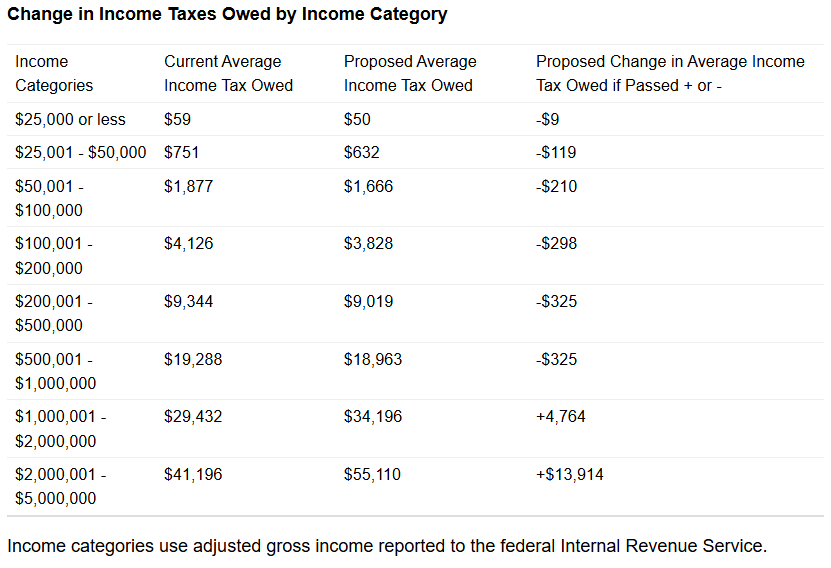
SHALL STATE TAXES BE INCREASED $2.7 BILLION ANNUALLY, IN ORDER TO INCREASE OR IMPROVE LEVELS OF PUBLIC SERVICES, INCLUDING K-12 PUBLIC SCHOOL EDUCATION, HEALTH CARE, AND EARLY CHILD CARE AND EDUCATION SERVICES, BY AN AMENDMENT TO THE COLORADO CONSTITUTION AND A CHANGE TO THE COLORADO REVISED STATUTES REPEALING EXISTING LAW AND CREATING NEW LAW TO REPLACE THE UNIFORM STATE INCOME TAX RATE WITH A GRADUATED INCOME TAX STRUCTURE, AND, IN CONNECTION THEREWITH, AMENDING THE TAXPAYER’S BILL OF RIGHTS TO ELIMINATE THE CONSTITUTIONAL REQUIREMENT FOR ALL TAXABLE NET INCOME TO BE TAXED AT ONE RATE WITH NO ADDED TAX ON INCOME; ESTABLISHING VARIOUS INCOME TAX RATES BASED ON THE AMOUNT OF TAXABLE INCOME EARNED BY INDIVIDUALS, ESTATES, TRUSTS, AND CORPORATIONS, WHILE MAINTAINING THE CURRENT 4.4% TAX ON INCOME FROM THE SALE OF A PRINCIPAL RESIDENCE, WHICH WILL RESULT IN THE ESTIMATED CHANGE IN INCOME TAXES OWED BY INDIVIDUALS AS IDENTIFIED IN THE FOLLOWING TABLE; AND AUTHORIZING THE STATE TO RETAIN AND SPEND ANY INCREASED REVENUE FROM THE NEW TAX STRUCTURE, AS A VOTER-APPROVED REVENUE CHANGE, TO SUPPLEMENT CURRENT LEVELS OF FUNDING FOR K-12 PUBLIC SCHOOL EDUCATION, HEALTH CARE, AND EARLY CHILD CARE AND EDUCATION PROGRAMS?
Translation
This measure would replace Colorado’s flat income tax with a graduated income tax, where people with higher incomes pay a higher rate than people with lower incomes. It would also allow the state to keep and spend the additional revenue on K–12 education, health care, and early childhood programs. As you can see in the table above and on your ballot, most taxpayers would pay less than they do now. Only very, very, very, VERY high‑income households would pay more.
My Take
Colorado’s flat tax means a grocery clerk and someone making $5 million a year pay the same tax rate. 4.4% of $20,000/year is money someone needs for medication, food, or rent. 4.4% percent of $5,000,000/year does not have the same impact. This measure would finally change that inequity. Unless you make over $1 million a year, your taxes will go down. That’s how wealthy the top earners are in Colorado: you have to climb past seven‑figure incomes before people would start to pay more taxes instead of less. If trickle-down economics worked the way the 1% says it does, we'd all be swimming in money by now. I'll vote "Yes."
Proposition NN
Ballot Language
Shall state investment in K-12 public education increase two percent each year for the next ten years, with investments used to increase teacher pay, improve teacher retention, lower class sizes, and increase access to career and technical courses, without raising taxes but instead funded by raising the annual limit on state fiscal year spending only by the amount spent on public K-12 education as a voter-approved revenue change, and requiring an annual publicly released, independent audit to show how the new investments are spent?
Translation
This measure would increase state funding for K–12 public education by 2% each year for the next ten years. The money would go toward things like higher teacher pay, better teacher retention, smaller class sizes, and more access to career and technical courses. It wouldn’t raise taxes or change anyone’s tax rate, though our meager TABOR refunds would be meager-er than they are today. The measure also requires an annual independent audit showing how the new funding is used.
My Take
Under TABOR, we've underfunded public schools for thirty years. This measure aims to reduce the damage by giving K–12 education stable funding. It would slightly reduce TABOR refunds for the next 10 years. In the first two years, a single filer making $100,000/year will trade an average of $48 in individual refunds to give K-12 schools reliable funding (an average of $76 for joint filers). I'll vote "Yes."
Proposition 132
Ballot Language
Shall there be a change to the Colorado Revised Statutes concerning criminal penalties for fentanyl and certain synthetic opioids, and, in connection therewith, increasing the felony classifications of drug-related crimes for distribution, manufacturing, dispensing, sale, or possession of fentanyl and certain synthetic opioids; creating mandated treatment for certain drug felony violations based on possession amount; and changing sentencing provisions to narrow or eliminate exemptions for crimes related to fentanyl and certain synthetic opioids and drug-related deaths?
Translation
This measure would make the criminal penalties for fentanyl much harsher. Right now, if someone is caught with a small amount (e.g., a single pill), judges have options like probation or treatment. This measure would make possessing any amount of fentanyl much more likely to result in mandatory prison or jail time. Nonpartisan analysts say Prop 132 would increase Colorado’s prison population and cost taxpayers millions every year, around $142 million over five years, and $400 million more to build a new prison to accommodate a higher population.
My Take
If tougher penalties solved the addiction crisis, we’d have ended it by now. There are so many ways to spend half a billion dollars that would actually help Coloradans, including those struggling with substance use, instead of pouring it into longer prison sentences and new prison beds. Advance Colorado seems to be looking for yet another way to divert taxpayer money to their friends… this time in the private prison industry. I'll be voting "No."
Proposition 133
Ballot Language
Shall there be a change to the Colorado Revised Statutes modifying existing law concerning human trafficking of a minor for sexual servitude, and, in connection therewith, creating new law expanding human trafficking of a minor for sexual servitude to include knowingly trading anything of monetary value to buy or sell sexual activity with a minor and increasing the penalty to be life in prison without parole or release?
Translation
Colorado law already makes human trafficking of a minor for sexual servitude one of the most serious crimes in the state, with long prison sentences and a legal defense for victims who were forced or coerced into participating. This measure would go further by expanding the definition of child sex trafficking to include knowingly trading anything of value to buy or sell sexual activity with a minor. It also replaces the current sentencing range with a mandatory life in prison without parole sentence, which means judges would no longer be able to consider whether someone was coerced, threatened, or acting under the control of a trafficker.
My Take
Colorado already has tough penalties for child sex trafficking, while recognizing that victims can be forced or coerced into helping their traffickers. This measure removes the ability for courts to consider coercion at all, and groups like Cobalt warn it could create new risks for people helping minors access abortion care or gender-affirming healthcare. It’s part of the same “Protect Kids Colorado” campaign pushing the next two blatantly anti‑trans measures. I'll be voting "No."
Proposition 134
Ballot Language
Shall there be a change to the Colorado Revised Statutes creating new law restricting participation in all K-12 and collegiate school sports based on the participant's sex as determined by certain aspects of their biological reproductive system, and, in connection therewith, requiring a school, institution of higher education, or athletic association to designate each school or intramural athletic team or sport as male, female, or coeducational; only allowing participants to compete on the team or sport of their designated sex or to compete on a coeducational team; creating an exception to allow a female to participate on a male-designated team or sport if there is no female team available; prohibiting a government entity, licensing or accrediting organization, or athletic association from entertaining a complaint, opening an investigation, or taking other adverse action against a school for maintaining separate teams or sports for females; and providing the commissioner of education with the authority to enforce the proposed initiative for K-12 school districts?
Translation
This measure would require all K–12 and college sports teams in Colorado to be labeled as male, female, or co‑ed based only on a student’s “biological reproductive system.” Students would only be allowed to play on the team that matches that designation, unless they join a co‑ed team. Because the measure doesn’t define how a school must determine a student’s sex or how disputes are handled, it could lead to situations where any student, including cisgender girls and cisgender boys, is forced to prove their sex if someone challenges them. The measure also blocks schools from being investigated for excluding trans students and gives the Commissioner of Education new authority to enforce these rules in K–12 districts.
My Take
“Protect Kids Colorado” has an unusual fixation on kids’ sex. This measure would ban transgender girls and boys from playing on the teams that match their gender identity, and it creates a system where any kid could be forced to “prove” their sex if someone decides they don’t look masculine or feminine enough. It protects schools that illegally exclude trans students and gives the state new enforcement power to make sure districts comply. Our children have enough to deal with without being forced to prove their sex just to play soccer. I’ll be voting “No.”
Proposition 135
Ballot Language
Shall there be a change to the Colorado Revised Statutes modifying existing law by prohibiting surgery on a minor for the purpose of altering the minor's biological sex characteristics, and, in connection therewith, prohibiting any health-care professional or other person from knowingly performing, prescribing, administering, or providing any surgery to a minor for the purpose of altering the minor's biological sex characteristics and prohibiting the use of state or federal funds, Medicaid reimbursement, or insurance coverage to pay for this type of surgery?
Translation
This measure would ban doctors from performing any surgery on a minor for the purpose of changing the minor’s sex characteristics. It would also ban anyone from prescribing, administering, or providing any surgery for that purpose, and it prohibits state or federal funds, Medicaid, or insurance from covering it. Current law already limits gender‑affirming care. This measure would create a new criminal ban and new financial restrictions that could also affect young people who need surgery for medical reasons related to how their bodies developed.
My Take
Seriously, what is with Protect Kids Colorado's fixation on kids' sex? Surgery for trans minors is already rare in Colorado. Kids don't wake up thinking "Hey! I'm trans!", tell their parents, and get surgery later that day. Many trans kids don't come out to their parents before they are 18, and when they do come out, they don't jump straight to surgery. If a child under 18 has reached the point where they and their parents feel surgery is the safest option, they deserve that choice, much like children under 18 deserve the choice to have an abortion. This measure would block families from using insurance or Medicaid and could interfere with medical care for cisgender kids whose bodies didn’t develop typically. Kids deserve appropriate healthcare regardless of their gender identity. I’ll be voting “No.”
Proposition 136
Ballot Language
Shall there be a change to the Colorado Revised Statutes capping the state income tax rate at 4.4% of federal taxable income for individuals and corporations?
Translation
This measure would lock Colorado’s income tax rate at 4.4% for both individuals and corporations. The legislature would not be able to raise the rate above 4.4% in the future, even if voters approved a change. Colorado already has one of the lowest flat income tax rates in the country; capping it would permanently limit our ability to fund schools, health care, transportation, and other public services.
My Take
Advance Colorado is back with another “give wealthy people all the money” idea. Colorado already has one of the lowest income tax rates in the country. Locking it at 4.4% would permanently tie the state’s hands no matter what future voters want or what our schools, roads, or health systems need. Inflation keeps raising the cost of everything the state pays for, but a permanent cap means state revenue doesn't have a chance of keeping up. It’s part of a long‑running conservative effort to starve public services and then complain they don’t work. I’ll be voting “No.”
Proposition 137
Ballot Language
Shall there be a change to the Colorado Revised Statutes creating new law to increase water and land conservation funding without raising taxes, and, in connection therewith, through a voter-approved revenue change, allowing the state to keep and spend a portion of revenue from the state sales tax on sporting goods and equipment to conserve and protect Colorado's water, land, and forests, prevent wildfires, support outdoor recreation training and activities, and reduce revenue spent on these conservation purposes if necessary to preserve funding for certain tax credits?
Translation
This measure would let the state keep and spend part of the existing sales tax on sporting goods and outdoor equipment to pay for water, land, and forest conservation, wildfire prevention, and outdoor recreation programs. The measure doesn’t create new revenue, so any dollars directed to conservation would come out of the General Fund, which is already struggling to pay for schools, health care, transportation, wildfire mitigation, and other core services.
My Take
This looks like “free money for conservation,” but it just takes money out of the state's General Fund, which is already stretched beyond its limits as costs rise every year. It’s a General Fund money grab dressed up as conservation, and it could end up forcing cuts to other essential services. I’ll be voting “No.”
Boulder County Ballot Measures
In Colorado counties, Ballot Issues are TABOR fiscal measures; Ballot Questions are everything else. Of the three Boulder County measures, only one was placed on the ballot by the Board of County Commissioners (Ballot Issue 1A). The other two came from citizen petitions, funded largely by outside money and circulated mostly using paid signature gatherers.
In full disclosure, I have been working with a diverse group of stakeholders on 1A for nearly two years. The Early Childhood Council of Boulder County spent 18 months convening a group of community leaders, school district officials, parents, business leaders, childcare providers, and city and county elected officials to create a collaborative measure that had broad support. The outcome of this diverse group was Ballot Issue 1A, which the County Commissioners voted to place on the ballot. Learn more at www.BrighterStartBoulderCounty.org.
I have also been helping the group of current and former County Commissioners who are against Ballot Question 200. Ballot Question 200 was organized by about 10 people, most of whom live or have businesses in the City of Boulder. This group raised a lot of money, through a few very large donations, mostly from people and organizations outside of Boulder County, to get Ballot Question 200 and 201 on the ballot by citizen petitions. Learn more at www.NoOn5Commissioners.com.
Ballot Issue 1A
Ballot Language
EARLY CHILDHOOD CARE AND EDUCATION MILL LEVY INCREASE AND VOTER-APPROVED REVENUE CHANGE
SHALL BOULDER COUNTY TAXES BE INCREASED $30,000,000 ANNUALLY (IN TAX COLLECTION YEAR 2027), AND BY SUCH ADDITIONAL AMOUNTS RAISED ANNUALLY THEREAFTER, BY A MILL LEVY IMPOSED AT A RATE OF 2.579 MILLS (EQUATING TO APPROXIMATELY $115 PER YEAR ON A $725,000 HOME BASED ON CURRENT RATES OF ASSESSMENT) FOR THE PURPOSE OF ADDRESSING THE SHORTAGE AND HIGH COST OF CHILD CARE AND PRESCHOOL PROGRAMS FOR BOULDER COUNTY FAMILIES WITH YOUNG CHILDREN, INCLUDING:
- LOWERING THE HIGH COST OF CHILD CARE AND PRESCHOOL FOR BOULDER COUNTY FAMILIES;
- INCREASING THE COMPENSATION OF CHILD CARE AND PRESCHOOL TEACHERS AND STAFF TO RETAIN AND ATTRACT HIGH-QUALITY EDUCATORS; AND
- ADDRESSING THE SHORTAGE OF CARE BY EXPANDING CAPACITY FOR MORE CHILDREN AND REDUCING WAITLISTS;
AND SHALL THE REVENUES AND EARNINGS ON THE INVESTMENT OF THE PROCEEDS OF SUCH TAX CONSTITUTE A VOTER-APPROVED REVENUE CHANGE UNDER ARTICLE X SECTION 20 OF THE COLORADO CONSTITUTION AND AN EXCEPTION TO THE LIMITATIONS SET FORTH IN SECTION 29-1-301 OF THE COLORADO REVISED STATUTES, ALL AS MORE PARTICULARLY SET FORTH IN BOARD OF COUNTY COMMISSIONERS' RESOLUTION NO. 2026-048?
Translation
Ballot Issue 1A asks voters whether Boulder County should create a dedicated property tax to improve access to childcare and preschool. It would add about $9.50/month (approximately $115/year) to the property taxes of a home valued at $725,000. The money would be used to lower childcare and preschool costs for low- and middle-income families, increase pay for early childhood teachers and staff, and reduce waitlists by expanding childcare and preschool capacity.
My Take
I noted above that I have been a part of this Ballot Issue's creation, because this issue is personal. Along with housing and healthcare, childcare is a main driver of unaffordability in Boulder County. When my family needed childcare 15 years ago, we paid about $1400/month per child. When I learned I was pregnant with our second child, I first called my husband and then called local daycares, because even part-time care for children ages 0-2 had 6-9 month waiting lists. Even so, my son was 6 months old when he started – it took 14 months for a spot to open up.
As a middle-income family, we paid for daycare by taking a second mortgage on our home and refinancing twice during the years we had two children in daycare. We relied on credit cards to pay for food and medical bills. We were fortunate that we were homeowners and could tap into the equity we had accumulated. In the past decade, the issues of affordability and accessibility have only increased. A year of full-time childcare now costs more than many colleges.
We all rely on childcare, even if we don't have children. Many of the workers who supply grocery stores, plow roads, respond to emergencies, or provide healthcare require childcare to do their jobs. And research shows that high-quality childcare pays dividends for communities in kids' cognitive and emotional outcomes. Especially as our population ages, it is far cheaper for us to all pay a little to invest in family wellbeing and children's success than to pay more for services because workers cannot afford our community, if we can find those services at all.
I'll vote "Yes."
Ballot Question 200
Ballot Language
Shall the membership of the Boulder County Board of Commissioners be increased from a three member board to a five member board?
Translation
Ballot Question 200 asks voters whether Boulder County should expand the Board of County Commissioners from three members to five. It does not specify how the five seats would be elected, how districts would change, how transitions would work, or what the cost or administrative impacts would be. Those details would be decided later, subject to state law governing redistricting (e.g., HB26-1038).
My Take
As someone who has pushed for electoral changes in our city that lead to more representative government, I understand the desire for better representation. But I do not see in these measures any of the structural changes that achieve more representative government. I'm also concerned this change will bias the Board of County Commissions toward the City of Boulder. Given our geography and population centers, and state requirements for county redistricting, it is entirely possible that three of the five commissioners could live in the City of Boulder. Boulder makes up at most one third of the county's population; we should not have the opportunity to control 3/5 of our county government.
If this measure came from a broad community process and had been placed on the ballot by the County Commissioners, I would feel differently. But it was placed on the ballot by a small group of individuals, mostly from the City of Boulder, who raised large donations – mostly from outside Boulder County – to fund paid signature gatherers. That doesn’t make it wrong, but it does give me pause when we talk about representation and whose perspectives influenced this proposal.
Increasing the number of commissioners also isn’t free. Adding two elected officials means adding staff, office space, administrative support, and approximately $500,000/year (at 2026 numbers) for ongoing salary and benefit costs. This comes at a time when many county programs and services our communities rely on are already facing significant cuts.
This change also doesn’t solve the representation issues people often raise. Boulder County’s population is concentrated in Boulder and Longmont. Under any realistic five-district map, those two cities would likely anchor four of the five districts. Under the three-district/two at-large map, the at-large races would likely go to candidates from population centers, who can raise significant amounts of money. In either scenario, rural communities could have less representation, not more.
Adding more commissioners doesn’t guarantee better functioning, either. I’ve seen firsthand that effectiveness depends on who voters elect, not how many seats exist. During 2024–2025, our own City Council struggled with long meetings, repeated recesses, and breakdowns in process — and that was with nine members. More seats don’t automatically create more collaboration or better outcomes.
Finally, many counties only have three commissioners because the role functions more like an executive than a legislative body. The majority of the commissioners' work is dictated by state law. Adding more commissioners won't change that constraint. Many counties our size, with budgets similar to ours, operate with three commissioners. It’s a common structure in Colorado, and it ensures the people elected are focused on serving the whole county.
For me, the question isn’t “three or five.” It’s whether this change actually solves the problems people hope it will. Based on the constraints of our electoral system and the realities of our geography, I don’t believe it does. I'll be voting "No."
Ballot Question 201
Ballot Language
If the membership of the Boulder County Board of Commissioners is increased from a three member board to a five member board, by what method shall the Boulder County Board of Commissioners be elected? (Vote for One)
- Five commissioners resident in districts to be elected only by voters resident in the district; or
- Three commissioners resident in districts to be elected only by voters resident in the district; plus two commissioners resident in any district to be elected by voters of the whole county.
Translation
Ballot Question 201 only applies if Ballot Question 200 passes. It asks voters to choose how a five‑member Board of County Commissioners would be elected from two options. Under the five-district option, the five commissioners would live in five separate districts, and only voters who live in each district would elect their commissioner. Under the three districts/two at-large option, three commissioners would be elected only by voters in their district, and two commissioners could live anywhere in the county and would be elected by all county voters. District boundaries would be decided later, subject to state law governing redistricting (e.g., HB26-1038).
My Take
Under our current system, Boulder County has three commissioner districts, and all three commissioners are elected by all Boulder County voters. Each commissioner must live in their district (District 1, 2, or 3), but we all vote on all three commissioners, regardless of which district they or we live in. Until we can figure out a proportional representation system, I prefer the current model, which is why I am voting "No" on Ballot Question 200.
Because at-large seats tend to favor candidates with more access to money and existing political networks, and this well-established bias is particularly strong in counties like Boulder County with one or two large population centers, I will vote for the five-district option.
City of Boulder Ballot Measures
Ballot Issue 2J
Ballot Language
RESIDENTIAL VACANCY EXCISE TAX (TABOR)
SHALL THE CITY OF BOULDER TAXES BE INCREASED $6,000,000 ANNUALLY (WHICH AMOUNT REPRESENTS ESTIMATED REVENUES IN 2028, THE FIRST FULL FISCAL YEAR OF COLLECTION), AND BY SUCH AMOUNTS RAISED ANNUALLY THEREAFTER, BY IMPOSING A $4,000 TAX ON VACANT HOMES THAT ARE OCCUPIED FOR 183 DAYS OR LESS PER YEAR, WITH SUCH AMOUNT NEVER FALLING BELOW $4,000 BUT INCREASING ANNUALLY IN ACCORDANCE WITH THE DENVER-AURORA-LAKEWOOD CONSUMER PRICE INDEX UP TO, BUT NEVER EXCEEDING $7,000, WITH THE REVENUE FROM SUCH TAX TO BE USED FOR THE PURPOSE OF SUPPORTING CITY SERVICES, INCLUDING: POLICE AND FIRE PROTECTION; PARKS AND RECREATION; TRANSPORTATION AND MAINTENANCE; AND OTHER GENERAL SERVICES IMPORTANT TO THE QUALITY OF LIFE IN THE CITY;
AND SHALL THE REVENUES FROM SUCH TAXES AND ANY RELATED EARNINGS BE COLLECTED, RETAINED, AND SPENT AS A VOTER-APPROVED REVENUE CHANGE WITHOUT LIMITATION AND AN EXCEPTION TO THE REVENUE AND SPENDING LIMITS OF ARTICLE X, SECTION 20 OF THE COLORADO CONSTITUTION?
Translation
Ballot Issue 2J asks voters whether Boulder should create a $4,000 tax on homes that are occupied for 183 days or less per year, starting in 2028. The tax would start at $4,000, increase annually with inflation, but never exceed $7,000. The money raised would go into the city’s general fund to support services such as police and fire, parks and recreation, transportation, and other general city services.
My Take
I don't disagree with the premise of charging for vacant homes given how heavily our city relies on sales tax, but I consistently voted against putting this measure on the ballot. Vacancy taxes are hard to enforce, structurally exposed to TABOR challenges, and they don't account for the administrative costs of enforcement.
As a tax, the city is locked into whatever number voters approve. In this case, the tax can only rise with inflation until it hits the $7,000 cap. Once it reaches that cap, the city can't adjust it without going back to voters. With typical inflation, that cap could be reached in 18-20 years; with higher inflation, closer to 12-14 years.
Because it’s a tax, the city also has to administer and enforce it using general fund dollars. That means taxpayers subsidize the cost of the tax. A fee structure would allow the city to adjust the amount over time to match the cost of administering and enforcing the program while adjusting for inflation; a tax cannot do that.
The ballot language estimates the tax would raise about $6 million in 2028, but this number is required by TABOR and is not based on verified data; city staff previously identified roughly 400 units that appeared vacant for more than six months, which would only generate about $1.6 million if all of them were taxable.
For these reasons, I'll be voting "No."
City of Boulder Ballot Issue 2K
Ballot Language
RECREATION AND SAFETY BOND (TABOR)
SHALL CITY OF BOULDER DEBT BE INCREASED UP TO $400,000,000, WITH A MAXIMUM REPAYMENT COST UP TO $650,000,000, AND SHALL CITY TAXES BE INCREASED UP TO $32,500,000 ANNUALLY FOR THE PURPOSE OF FINANCING THE CONSTRUCTION, RENOVATION, OR REPLACEMENT OF COMMUNITY RECREATION, SAFETY INFRASTRUCTURE, AND OTHER CAPITAL PROJECTS, SUCH AS:
I) THE SOUTH BOULDER RECREATION CENTER, INCLUDING A LAP POOL;
II) THE NORTH BOULDER RECREATION CENTER, INCLUDING AQUATICS AMENITIES AND IMPROVEMENTS NEEDED TO CO-LOCATE WEST AGE WELL SENIOR CENTER;
III) FIRE STATIONS (TO SUSTAIN EMERGENCY AND WILDFIRE RESPONSE CAPABILITIES);
IV) A NEW PUBLIC SAFETY BUILDING FOR POLICE AND 911 SERVICES;
V) PENFIELD TATE II MUNICIPAL BUILDING; AND
VI) THE MUNICIPAL SERVICE CENTER (TO SUPPORT INFRASTRUCTURE SERVICES, SUCH AS SNOW REMOVAL, UTILITY MAINTENANCE, AND CITY STREET OPERATIONS);
IN ORDER TO SUPPORT RECREATION, SAFETY, AND CRITICAL INFRASTRUCTURE NEEDS FOR COMMUNITY MEMBERS OF ALL AGES;
THROUGH THE ISSUANCE AND PAYMENT OF GENERAL OBLIGATION DEBT, WITH SUCH DEBT CONTAINING SUCH TERMS, NOT INCONSISTENT HEREWITH, AS THE CITY COUNCIL MAY DETERMINE; AND IN CONNECTION THEREWITH,
SHALL AD VALOREM PROPERTY TAXES BE LEVIED WITHOUT LIMITATION AS TO THE RATE, BUT NOT MORE THAN THE AMOUNTS LISTED ABOVE, TO GENERATE AN AMOUNT SUFFICIENT IN EACH YEAR TO PAY THE PRINCIPAL OF, PREMIUM, IF ANY, AND INTEREST ON SUCH DEBT OR ANY REFUNDING DEBT (OR TO CREATE A RESERVE FOR SUCH PAYMENT); AND
SHALL THE PROCEEDS OF SUCH DEBT AND RESERVES AND THE REVENUES FROM SUCH TAXES AND ANY INVESTMENT INCOME EARNED FROM SUCH PROCEEDS AND REVENUES BE COLLECTED AND SPENT WITHOUT LIMITATION OR CONDITION AS A VOTER-APPROVED REVENUE CHANGE AND AN EXCEPTION TO THE LIMITS THAT WOULD OTHERWISE APPLY UNDER ARTICLE X, SECTION 20 OF THE COLORADO CONSTITUTION OR ANY OTHER LAW?
Translation
Ballot Issue 2K asks voters whether Boulder should issue up to $400 million in general‑obligation bonds to rebuild or replace several major city facilities. Because these are bonds, the total repayment cost could be up to $650 million over time. To pay for the bonds, the measure would allow the city to increase property taxes by no more than $32.5 million per year, with the exact amount depending on how much debt is issued and the repayment schedule.
The bond would fund construction or replacement of:
- South Boulder Recreation Center, including a lap pool
- North Boulder Recreation Center, including aquatics improvements and co‑location of the West Age Well Senior Center
- Fire stations, to support emergency and wildfire response
- A new public safety building and communications center for police and 911 services
- Penfield Tate II Municipal Building renovations to provide more spaces for community use
- The Municipal Service Center, which supports the city's vehicle fleet and facilities operations (e.g., snow plowing, building maintenance, OSMP vehicles)
Voters are also being asked to allow the city to levy property taxes up to the stated annual amount to repay the debt. This measure does not fund ongoing operations; it only funds one-time renovations and replacements.
My Take
Boulder’s recreation centers, fire stations, police facilities, and core service buildings average 47 years old and many no longer meet modern safety, accessibility, or operational standards. Many of these facilities are past their useful life, and continuing to defer replacement only increases long‑term costs and risks.
This bond would enable the city to rebuild critical infrastructure we all rely on, including recreation centers, fire stations, public safety building, and emergency communications.
General‑obligation bonds are the most cost‑effective way for cities to fund major capital projects. They're sort of like a mortgage. They allow us to pay for the buildings now, when the need is urgent, and repay the debt over time. Future City Councils would issue the bonds in phases based on project readiness, cost estimates, and construction sequencing. The city does not have the capacity to do all these replacements at once, so the additional property tax would accrue gradually in future years versus appearing all at once.
I voted to put this measure on the ballot because these projects are overdue, and delaying them will only make them more expensive or result in cuts to existing programs and services that rely on these spaces. We do not have a Plan B. Rebuilding our recreation centers, fire stations, public safety facilities, and core service buildings is an investment in safety, resilience, and community wellbeing.
I’ll vote “Yes.”
For more information on this bond
- Read about the bond and the buildings it will fund here.
- Find an estimate of how your taxes would be impacted here.
- Listen to my recent comments on the Boulder Valley Frequency podcast here.
- Read the many articles I and my current and former Financial Strategy Committee colleagues have written on this topic:
- Boulder’s Recreation and Safety Bond is about keeping what we have
- Boulder's facilities funding debate deserves facts, not misinformation
- We must fix Boulder's aging infrastructure
- When it comes to prioritizing Boulder's facilities, the community must weigh in
- Setting the record straight on Boulder's finances
- Read the history of the Alpine-Balsam/Western City Campus project to see how thoughtfully the city approaches infrastructure work.
City of Boulder Ballot Question 2L
Ballot Language
Bargaining Rights Union Firefighters in City Charter
Shall the City amend its charter by the addition of a new Sec. 73, "Collective Bargaining for Firefighters," as described in Ordinance 8761 which provides a charter guaranteed right for full-time fire department employees to bargain collectively over matters related to safety, wages, benefits, and all other terms and conditions employment, except those certain terms that are reserved to rights of management as defined in the proposed charter amendment, with impasse to be resolved through non-binding factfinding followed, if necessary, by a vote of the qualified electors of the City?
Translation
This measure asks voters whether to add a new section to the city charter giving full‑time Boulder firefighters the right to bargain collectively over wages, benefits, safety, and other working conditions. Certain management rights, like staffing levels, deployment decisions, and operational control, would remain with the city. If the city and the union reach an impasse, the process would move to a non‑binding factfinding process. If they still cannot reach agreement, the final decision would go to Boulder voters. This measure does not set contract terms; it simply establishes the structure for collective bargaining in the city charter.
My Take
This measure reflects a good‑faith, collaborative negotiation between the city and our firefighters. Both sides worked together to design a charter amendment that protects management rights, supports safety and operational needs, and gives firefighters the bargaining rights ever worker deserves. I’ll vote “Yes.”
City of Boulder Ballot Question 2M
Ballot Language
Debt Limit City Charter Language Change
Shall Section 97 of the Boulder Home Rule Charter be amended pursuant to Ordinance 8762 to modify the City's debt limitation to be not more than three percent of the actual value of the taxable property within the City?
Translation
This measure asks voters whether to update the city charter’s debt limit so that Boulder can issue general‑obligation debt up to three percent of the total taxable value of property in the city. This change doesn’t authorize any specific project or borrowing on its own. It simply updates the cap so the city can issue voter‑approved debt in alignment with modern best practices.
My Take
Right now, Boulder’s debt cap is based on assessed value, which is only a small fraction of actual market value. Switching to a cap based on actual value is the standard approach used across Colorado and better reflects the real value of property in the city. This change doesn’t raise taxes, doesn’t authorize any new borrowing, and doesn’t increase costs for residents. It simply modernizes the charter so future voter‑approved bonds can be issued efficiently and in line with current municipal finance practices. I’ll vote “Yes.”
Front Range Passenger Rail District Ballot Measures
Ballot Issue 7A
Ballot Language
SHALL FRONT RANGE PASSENGER RAIL DISTRICT TAXES BE INCREASED $295,000,000 ANNUALLY AND BY WHATEVER AMOUNTS ARE RAISED ANNUALLY THEREAFTER, AND SHALL FRONT RANGE PASSENGER RAIL DISTRICT DEBT BE INCREASED $580,000,000, WITH A REPAYMENT COST OF $785,000,000;
TO CONSTRUCT, OPERATE, AND MAINTAIN COLORADO CONNECTOR (COCO) PASSENGER RAIL SERVICE ON COLORADO'S FRONT RANGE AND CONNECT COMMUNITIES, INCLUDING PUEBLO, COLORADO SPRINGS, STERLING RANCH, LITTLETON, DENVER, WESTMINSTER, BROOMFIELD, LOUISVILLE, BOULDER, LONGMONT, LOVELAND, AND FORT COLLINS; IN ORDER TO:
- REMOVE VEHICLES FROM HIGHWAYS AND INCREASE TRAVEL CAPACITY;
- CONNECT TRAVELERS TO EMPLOYMENT CENTERS, COLLEGES, SPORTS ARENAS, AND ENTERTAINMENT HUBS ALONG THE FRONT RANGE; AND
- INVEST IN STATION AREA IMPROVEMENTS AND LOCAL CONNECTIONS TO RAIL STATIONS;
BY ESTABLISHING A 0.333% SALES AND USE TAX (EQUAL TO ONE THIRD OF A PENNY ON A $1 PURCHASE), WITH EXEMPTIONS PROVIDED UNDER COLORADO LAW, INCLUDING THOSE FOR GASOLINE, FOOD, RESIDENTIAL ELECTRICITY AND GAS, PRESCRIPTION DRUGS, AND MEDICAL SUPPLIES;
AND TO RETAIN ALL SUCH REVENUES, PUBLIC AND PRIVATE CONTRIBUTIONS, AND ANY INVESTMENT INCOME ON REVENUES AND DEBT PROCEEDS, AS A VOTER-APPROVED REVENUE CHANGE UNDER SECTION 20 OF ARTICLE X OF THE COLORADO CONSTITUTION;
AND REQUIRING THAT ALL SUCH DEDICATED REVENUES BE REVIEWED ANNUALLY BY AN INDEPENDENT AUDITOR AND A ROTATING GROUP OF CITIZEN TAXPAYERS WHO LIVE IN THE DISTRICT?
Translation
Ballot Issue 2M asks voters whether the Front Range Passenger Rail (FRPR) District should create a 0.333% sales and use tax (one‑third of a penny on a $1 purchase) to build, operate, and maintain the Colorado Connector passenger rail service between Pueblo and Fort Collins, with additional stops in cities along the Front Range including Colorado Springs, Denver, Westminster, Broomfield, Louisville, Boulder, Longmont, and Loveland. The measure also authorizes the District to issue up to $580 million in bonds, with a maximum repayment cost of $785 million. The tax revenue would be used to fund construction, operations, station improvements, and local connections to rail stations. Certain items like gasoline, groceries, residential utilities, prescription drugs, and medical supplies are exempt under state law. This measure funds the starter service for Front Range Passenger Rail; it does not set fares, station locations, or service schedules.
My Take
This measure has been a long time coming. In my role as Boulder's representative to the Denver Regional Council of Governments (DRCOG), I can attest that communities up and down the Front Range have worked together with each other and the state for years to create a rail system that connects major cities along the corridor. A starter rail line between Pueblo and Fort Collins would give the region a backbone for long‑distance travel that doesn’t rely on I‑25.
Other metro areas use regional rail to connect local transit systems, making it easier for people to move between cities with larger geographic distances between them while getting cars off major highways. FRPR would create reliable, long‑term, high‑capacity connections between communities. If you’ve used regional rail in the Northeast or on the West Coast, you know how helpful these systems can be, especially as traffic congestion and travel costs increase.
I know some people feel burned by the FasTracks promise of light rail for Boulder 20 years ago, but FasTracks didn’t have the statewide partnerships or formal agreements that FRPR has. This is a different project with a different organizational structure and different commitments. I'll vote "Yes."